
How a corporate job, a full-time artist, two kids in public school, and one income still adds up to 8+ trips a year.

The question I get the most isn’t where we travel. It’s how.
“How do you guys do it? Like, really. With your jobs? With the kids in school?”
I used to mumble something about being lucky. The truth is the opposite — luck has almost nothing to do with it. We’re not richer than you. We don’t have more flexibility at work. We’re not on vacation. We’re just stubborn about planning, and we’ve built a system that quietly turns the same calendar everyone else is staring at into 8+ family trips a year.
I want to share that system today — every sneaky thing we do — because I am very tired of letting people assume travel is for other families. It is not. It is for you. You just need a strategy.
Pull up the kids’ school calendar. Let’s go.
The setup, so you know I’m not bluffing
- Me: Full-time, corporate. Salaried with limited PTO.
- Him: Full-time artist. Working from home, but truly working.
- Kids: Two of them. Public school. Aged enough to be on a real school calendar with real attendance expectations.
- Income: Mostly one. We live on it.
- Travel: Two or three big trips a year. Six to seven smaller ones. Domestic, international, beach, city, road trip. The whole spectrum.
I am writing this from the spreadsheet I open every January, the one I’ll open again next January, and the one I’m betting will hold up for the next ten years. The system works.
Here’s what’s in it.
The mindset shift: we’re not lucky. We’re strategic.

This is the part most travel blogs skip, and it’s the most important part.
Every family trip we take starts as a Google Doc. The school calendar is open in the next tab over. A points spreadsheet is open in another. Sometimes I have flight search engines open in three tabs at the same time and a notes app filling up with sweet-spot redemptions and award availability windows.
It looks chaotic. It is not. It is a system, and the system is the whole reason we travel.
If you take one thing from this post, take this: if it isn’t on the calendar, it doesn’t happen.
The seven tactics below are how we make sure the calendar fills up — every year, without fail, without burnout.
Tactic 1 — Every PTO day is on the calendar by January
I get a fixed number of PTO days a year. (I’m not going to say how many, because it doesn’t matter — your number is your number, and the principle is the same.)
The day I get them, I do something most working moms don’t:
I block every single one of them on the calendar before the year starts.
I don’t wait for permission. I don’t wait for a vacation idea. I don’t wait for someone else to plan something. I just put them on the calendar as placeholders, often pinned to a school break or a long weekend to extend it. Some are “TBD.” Some get firm destinations later. Most turn into trips by the end of the year.
The mental shift: PTO isn’t a reward I earn through stress. It’s a tool I deploy through planning.
Tactic 2 — Long weekends are trips, too
The American school year averages 6–8 federal holidays. Then there are the random teacher workdays, MEA days, professional development half-days, and early-release Fridays that schools sneak in.
If you add them up, you’ll find your kids have significantly more days off than you realize.
Every single one of them becomes a long weekend. That’s the rule.
A long weekend isn’t a “mini break” or a consolation prize — it’s a real trip. Three school days off plus one PTO day plus the weekend is a 5-night trip. We use a long weekend the way other families use a full week. The math works out beautifully, the school doesn’t penalize you, and you come back rested.
Recent long-weekend trips that hit that formula: Las Vegas in early spring. Florida Keys in October. New Orleans in February. Charleston in November. None of them required taking the kids out of school.
Tactic 3 — Friday-after-school is our departure time
We live 20 minutes from the airport. This is one of the few things that’s actually lucky, but you can engineer something similar wherever you live.
Here’s the routine: my kids walk out of school at 3pm. By 3:15, we’re in the car. Bags are pre-packed and sitting by the door — I packed Wednesday night. By 4:00, we’re checking in. By 6:00, we’re wheels up.
By the time most families are sitting down to dinner on Friday, we’ve already started our trip.
That single hack turns every weekend trip into a 3-night trip instead of a 2-night trip. Over a year, it adds weeks of vacation.
The pre-pack is non-negotiable. I lay out outfits on Tuesday. I pack on Wednesday. By Thursday night, the bags are zipped and the boarding passes are saved to my wallet. The Friday departure only works if Friday morning is the same as any other morning.
Tactic 4 — The school calendar is my trip planner
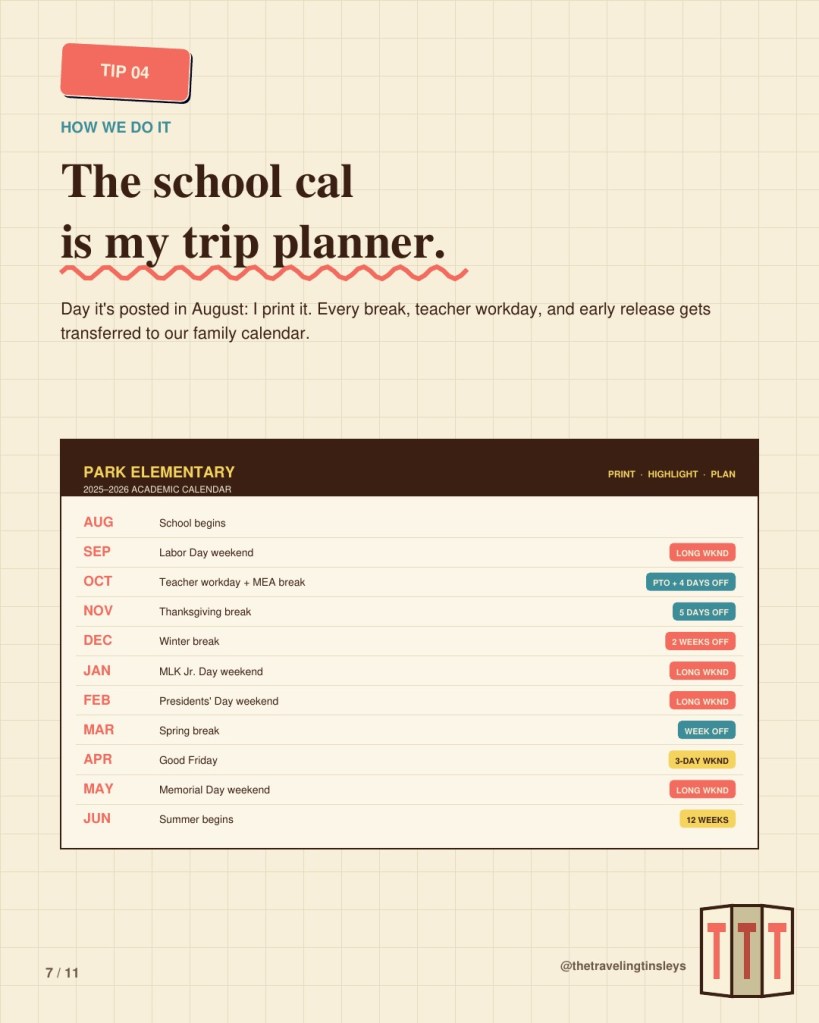
The day my kids’ school calendar gets posted in August, I print it. Two copies. One goes on the fridge. One goes in my planner.
I highlight every break. Every teacher workday. Every early release. Every long weekend. Then I overlay it with my work calendar and the year’s federal holidays.
What I’m looking for: the natural pockets where one or two PTO days can stretch a school break into a real trip.
This is also where I figure out when not to travel. Some weeks are too packed to leave. Other weeks (spring break in March, the week between Christmas and New Year’s) are obvious and I plan around them.
By the end of August, I have a draft year of trip windows. By January, I’ve turned them into a calendar of confirmed bookings.
I keep the school calendar visible all year. Every trip-planning decision starts there.
Tactic 5 — We book a year in advance
This sounds intense. It isn’t.
Most airline award charts open 11–12 months before the flight date. Hotel award charts open even earlier. The best seats — lie-flat business class on the route you actually want, the all-inclusive resort during the week of spring break — get booked the same day they’re released.
By the time most families start thinking about summer, ours is already locked in.
A typical year’s booking timeline for us looks like:
- January: Confirm spring break trip. Book flights + hotel on points.
- March: Confirm summer big trip. Book flights + hotel on points. Start watching cash flight prices for any sales.
- June: Confirm fall trip. Book.
- August: Confirm Thanksgiving + winter break. Book.
Then through the year, I’m watching every long-weekend window and dropping smaller trips into them as the cash and points line up.
It’s not work, exactly. It’s more like a slow-drip hobby that pays off every couple of months in airline emails that say “you’re confirmed.”
Tactic 6 — I search constantly, and I pivot when I find a deal
This is the difference between a system that works and a system that just sits there.
I have destinations in mind for the year, but they aren’t locked. If award availability for Italy suddenly opens at half the points of Greece, Italy moves up the list. If a points-friendly resort in Mexico drops by 30% on Hyatt’s chart, that’s where we’re going in March.
I check things constantly — like, multiple times a week, often daily during big planning windows. Tools I rely on:
- point.me (or Points Yeah) — cross-program flight award search.
- Aeroplan’s award engine — for confirming Star Alliance seats actually exist before transferring points.
- MaxMyPoint — for hotel award availability across Hyatt, Hilton, Marriott, IHG.
- Doctor of Credit and Frequent Miler — for credit card sign-up bonus tracking.
- The Hyatt category chart — bookmarked.
The mindset is: I have a wish list, but I’m a deal-chaser. When the deal shows up, I take it. The trip we book is the trip the points wanted us to book.
That’s how we ended up in Matera, Italy in 2022 — not on the original list, but the redemption was incredible and the destination ended up being one of the most special trips we’ve taken as a family.
Tactic 7 — Points and miles do the heavy lifting
I’m going to be honest with you: we travel this much because we are aggressive about points.
We open the right credit cards (and pay them off in full every single month). We rotate through sign-up bonuses every 60–90 days, between me and my husband. We refer each other. We use shopping portals. We’re members of every loyalty program. We track everything in a spreadsheet.
Every sign-up bonus, on average, is one big family trip. Two adults running the cycle thoughtfully means we’re earning enough points each year for international flights for four plus a week of hotel nights. Not theory — that is what is currently sitting in our accounts.
I’m not going to bury the lead: we don’t trade money for travel. We trade time, planning, and points.
If you have decent credit, no card debt, and the discipline to pay statements in full — you can do exactly what we do. I have a whole separate starter guide coming on this (the long version with the cards I’d open first, in what order, with referral links). For now, just know: this is the multiplier that takes 2-3 trips a year and stretches it into 8+.
“But what about…”
Three objections I hear constantly. Quick answers.
“I can’t take time off work like that.”
I’d push back on that. Most working parents have more flexibility than they think — they just don’t ask for it. PTO is yours. Long weekends are yours. Half-day Fridays exist at a lot of companies and almost nobody uses them. You don’t need a whole week off to travel. You need a thoughtful Friday and a Monday.
“My kids are too young.”
Travel with little kids is hard. Travel with little kids is also building family memory and a kid who is comfortable in airports, on planes, in unfamiliar places. Our kids are better travelers at 8 and 6 than most adults I know — because we started in toddlerhood. Easier trips for now, harder trips later, but you build the muscle the same way you build any other family habit.
“We can’t afford this.”
This is the one I want to address most carefully, because money is real and points-and-miles is not magic.
What’s true: we don’t have unlimited disposable income. What’s also true: most of our trip costs are absorbed by points, sign-up bonuses, and credit card credits we’d qualify for anyway. The cash we spend on a trip is usually food, activities, and the occasional splurge — the kind of spending we’d be doing at home anyway, just in a more interesting setting.
If you are in credit card debt, points-and-miles is not the move. Pay that off first. If you have decent credit and no revolving debt, the math changes completely. That’s the system.
A real example, start to finish
Want to see what this looks like in practice? Here’s a recent trip, soup to nuts.
January: My school calendar shows MEA break in October (4 days off). I block it as a trip window and add it to the spreadsheet.
February: I notice award availability opens for fall flights to a destination I’ve been wanting to try. I check point.me — the route prices out cheaper in points than I expected. I confirm seats are real in Aeroplan’s search.
March: I transfer points from a flexible-points card to the airline. I book the flight. Total cost: $0 cash, just taxes.
April: I check Hyatt’s chart for hotels at the destination. Award nights are wide open. I book 4 nights with my Hyatt points. Total cost: $0.
August: School starts. I confirm the trip on the family calendar. Kids are excited.
September: I pre-shop souvenirs, snacks, and packing list. The Wednesday before, I pack. The Friday of, school ends, we leave for the airport.
October: We take a 5-night trip. Total cash outlay across the trip: a few hundred dollars of food and one rental car. No airline ticket spend. No hotel spend.
I started the planning 8 months out. The booking part took about 90 minutes total, spread across the year.
That’s the whole game.
If we can do this, so can you
This is the part I want to stay on.
We are not a special family. We’re not richer than you. We are not luckier than you. We have the same number of hours in the day, the same number of weeks in a year, and the same Google Doc you have.
What we have, that I want you to have, is the belief that this is figureoutable. The school calendar is figureoutable. The PTO calendar is figureoutable. The points are figureoutable. The Friday-after-school airport run is figureoutable.
Build the system. Trust the system. The trips show up like compound interest.
Your turn
I want to hear from you. What’s the one sneaky thing you do to make travel happen? The hack that other moms in your life don’t realize you’re running? The little planning move that turns “we should travel more” into actual boarding passes?
Drop it in the comments. I’m collecting a list, and I want it to be loud, honest, and useful.
If you found this helpful, the best thing you can do is share it with a fellow mom who keeps saying she wishes her family traveled more. She doesn’t need permission. She needs a system.
I’m cheering for you.
— Maggie
P.S. The Points + Miles Starter Guide is coming soon. If you want to be the first to know when it drops — including which cards I’d open first and in what order — make sure you’re following along on Instagram @thetravelingtinsleys or drop me your email.

